Sunday, August 8, 2010


Wednesday, August 4, 2010
It starts with the chickens
Today we got two 6 week old Ameraucana chickens. Their names are Henna and Starlight, with Henna being the larger dark headed pullet.
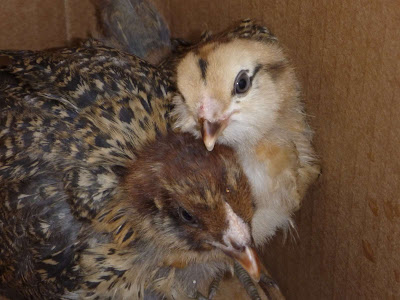
Karenna named Henna and Kalista named Starlight and they love the chickens. Perhaps a bit too much.

I made a chicken tractor for them which I think will work in our small lot.
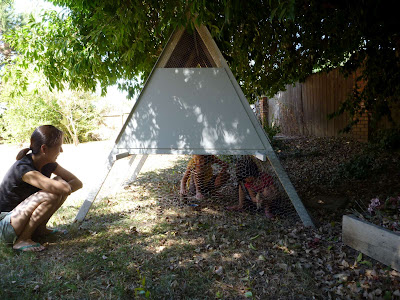
Karenna named Henna and Kalista named Starlight and they love the chickens. Perhaps a bit too much.
I made a chicken tractor for them which I think will work in our small lot.
Friday, June 11, 2010
Plant list
I'm trying to keep a list of plants I want to grow that I think will do well in the climate. I'll adjust this post as needed
Moringa
strawberry tree
Fig
Peach
california hazelnut - tolerates shade.
pacific blackberry - tolerates shade.
blueberry
New Zealand spinach
comfrey
nanking cherry
mulberry
Nasturtium
grapes
purslane
jerusalem artichoke, aka sunchoke
strawberry.
artichoke
pomegranate
mexican elderberry
pineapple guava
amaranth
Saturday, May 1, 2010
Moringa oleifera

I just found out about this plant and it's perfect for the inland empire. Moringa is often called the miracle plant because it is highly nutritious and every part of the plant is edible other than the bark. It grows extremely fast growing several feet per year and will start fruiting in the first year after it is planted from seed. The reason it is perfect is that it only requires 10 inches of rain per year, loves heat and can grow in poor soils. I plan to plant 20-30 trees and use them to make mulch as well as food for us and the chickens. When the soil has improved to the point we can grow other things, I'll thin them out and keep a couple.
You can read more about this amazing plant, at wikipedia.
Wednesday, March 24, 2010
Unintended consequences

And we wonder why honeybees are dying?
Luckily, there are things we can do to help the bees and in essence save our food supply.
There's a local group in socal called Backwards Beekeepers and they rescue local wild honeybees and allow them to be normal bees. I would do this myself but, I have anaphylaxis to bee stings so it's probably not a good idea for me but if you're interested, it's a good thing to do.
Monday, March 22, 2010
Do you eat like an SUV?
As it turns out, what you eat may be more important than what you drive. Industrialized agriculture is very fuel intensive. Millions of gallons of diesel are used to grow and harvest corn of which 76 percent go to feed animals. This corn is then shipped to feedlots. Animals are then shipped to slaughterhouses. Carcasses are shipped to packing plants. Meat is then shipped to your grocery. Animals also emit lots of greenhouse gases. So, as you can tell, there's a lot of fossil fuel burning going on in the name of a hamburger for lunch. Gidon Eshel and Pamela Martin have been studying the environmental impact of dietary choices and being a vegan is not surprisingly the most sustainable diet. In fact, the carbon footprint difference between a vegan and someone who gets 50% of his/her calories from meat is similar to the difference between driving a small car and an SUV.

We all knew that being vegetarian was better for our health and less cruel to animals - now we know that its better for the planet as well.

We all knew that being vegetarian was better for our health and less cruel to animals - now we know that its better for the planet as well.
Saturday, March 13, 2010
Sheet mulch!
So what's the first thing you do when you have a house with a lawn and you want to plant a garden? Dig it up right? This is done with a rototiller or a shovel. The ground is usually rock hard clay which is really hard to dig and pretty poor soil to grow a garden in. So after you till it, you have to put in fertilizer, compost, peat moss, etc, etc, etc. Tilling also spreads weed seeds and increases soil erosion because there is bare soil with nothing holding it in place. Let's me honest - it's a lot of hard work and no one wants a lot of work. Remember, this is supposed to be less work than having a lawn.
That's the beauty of sheet mulching. Sheet mulching aerates the soil, kills the weeds and grass, enriches the soil with organic material and prepares for garden planting all with ZERO digging. The basic idea is very simple - you layer 4 different layers right on top of your existing lawn and it will compost over time right into the ground.

That's the beauty of sheet mulching. Sheet mulching aerates the soil, kills the weeds and grass, enriches the soil with organic material and prepares for garden planting all with ZERO digging. The basic idea is very simple - you layer 4 different layers right on top of your existing lawn and it will compost over time right into the ground.

The first layer is shown as compost but I will use horse manure. There are a lot of people around Redlands with horses and I'm thinking they will likely be happy to have someone shovel up and haul away the manure. This layer should be 2-3 inches thick. You then spray some water on this layer to soak it through and wet the soil underneath.
The next layer is the weed barrier layer. You can use 6-8 sheets of newspaper, burlap, organic carpet, or cardboard. I'll use cardboard because its very easy to get. This layer keeps the grass and weeds underneath from growing through the manure. The sheets of cardboard must be overlapped by at least 6 inches.
The next layer will be leaves or hay or compost. This layer needs to be as free from weed seeds as possible since there is no barrier above this layer. I plan to see if i can get some rotten hay from local livestock growers. If that doesn't work, I'll buy some hay and spread that around. This layer should be 3-4 inches thick.
The last layer is to basically make the whole thing presentable to your neighbors. I'll buy some straw or find a tree trimmer that wants to get rid of wood chips or find a wood working shop and get sawdust and put this on top. This layer should be 3-4 inches thick as well.
Doing this should take one person less than a day once you have the materials collected to cover a decent sized plot. Now you wait several months. At the end of several months, there will be thousands of worms and trillions of beneficial soil bacteria in an area that used to be devoid of almost all soil life. The worms will dig up the soil and aerate the soil and it will be perfect for planting.
There's several good places to read further about it - here's one.
When we actually do this, I'll put up a post with pictures of it every step of the way start to finish.
Subscribe to:
Posts (Atom)